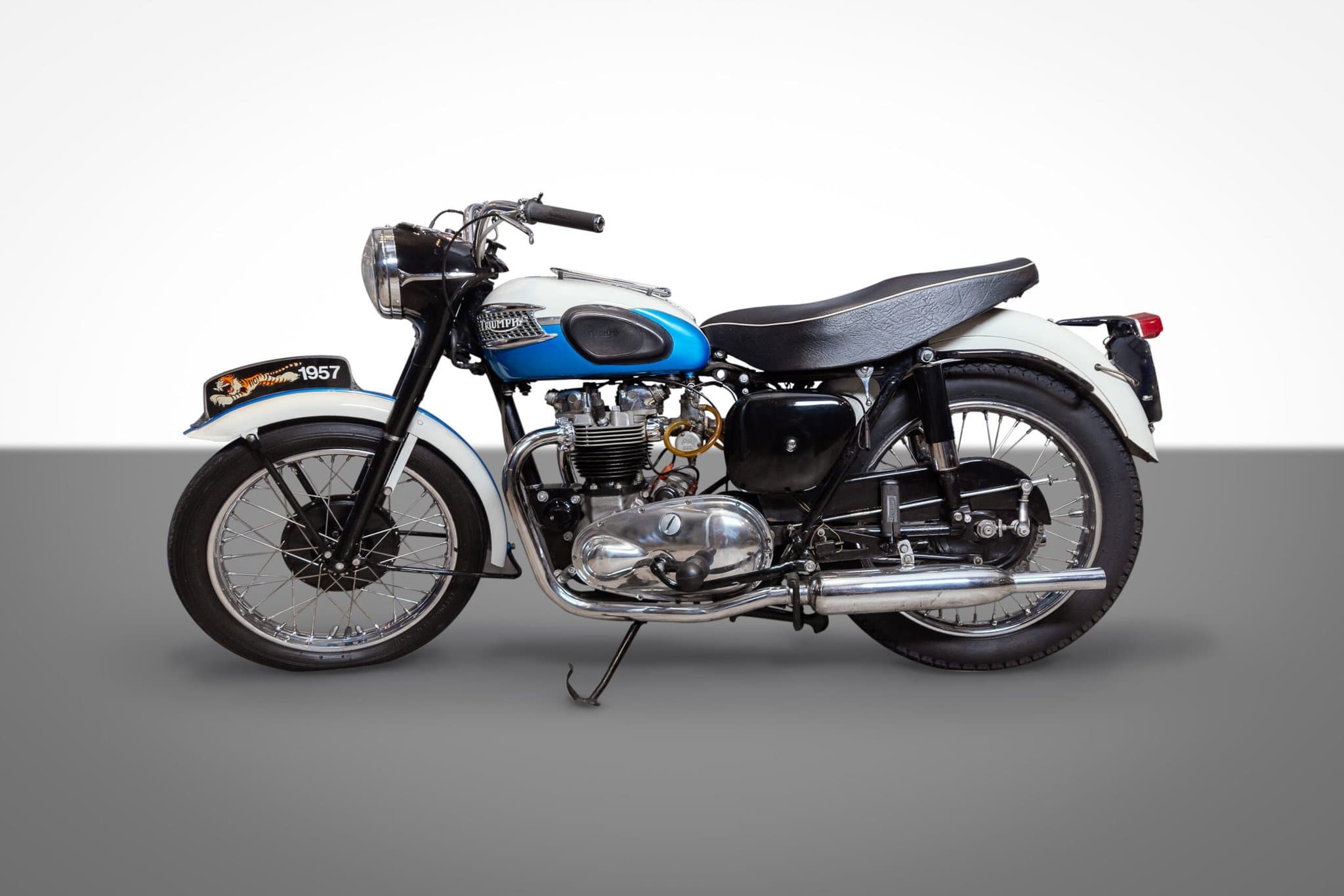
1957 Triumph Tiger T110: the full story
No one could have predicted back in 1883 that a small German-owned business in England selling bicycles and sewing machines would evolve into a company responsible for some of the fastest motorcycles the world had ever seen. In 1901, Siegfried Bettmann’s Triumph Engineering introduced its first motorized bicycle. Though modest compared to today’s motorcycles, 500 of these early machines sold quickly enough to justify the creation of the Model H design. Triumph’s early success led to it being commissioned to supply 30,000 motorcycles to Allied forces during World War I, solidifying a reputation built on reliability and ingenuity.
Triumph’s momentum was challenged once again during World War II, when relentless bombings destroyed much of Coventry, including the original Triumph factory. Despite such a tragic setback, the company lived up to its name. Just one year later, production resumed in a new Meriden facility, where Triumph continued its push toward even faster and more refined motorcycles. This path led to the development of an engine that would soon hold the world motorcycle speed record for fifteen years, a golden era in which Triumph emerged as the performance brand to beat.
The T110 was built in 1953 and introduced the following year as Triumph’s fastest and most powerful production motorcycle to date. It was designed as a sporty successor to the Triumph Thunderbird (1949-1966). By the 1957 model year, the Tiger T110 had firmly established its credibility among serious riders, its performance clearly separating them from casual enthusiasts. Early models featured a cast-iron cylinder block and head, but these were soon upgraded to a light-alloy cylinder head with improved cooling passages, austenitic iron valve seat inserts, and updated lubrication that replaced external oil-feed pipes with cleaner, more efficient internal oilways routed through the pushrod tubes.
This particular Tiger SS T110 is a 1957 four-speed model equipped with a right-hand shift gearbox, chrome badging, wire-spoke wheels, and both an Easy-Lift center stand and side kickstand. The enclosed rear bodywork, nicknamed “The Bathtub” due to its resemblance to an inverted bathtub, adds to its distinctive shape. Triumph pioneered this motorcycle’s 650 CC (40 cubic inch) OHV vertical twin for American markets. The engine is equipped with high dome pistons and a 8.5:1 compression ratio, adjustable rear suspension, as well as a Super-Sports camshaft that gives it the “SS” designation. The Tiger SS T110 was also fitted with a new exhaust system for minimum back pressure and adequate silencing, and the front fork was modified with improved hydraulic damping.
The SS Tiger T110 wears a shimmering two-tone blue and ivory tank and fender color combination with sparkling chrome and aluminum trim. The frames of every model in the 1957 line were finished in ebony black, and this one was also complemented by an improved ignition magneto, DC generator lighting set with automatic ignition control, and the air scoop in the 8-inch front brake adds bonus safety.
Produced from 1953 to 1961, the Triumph Tiger SS T110 earned its reputation through exhilarating speed and ambitious engineering, long before the age of electronically curated superbikes. During its reign as “the world’s fastest,” the T110 held its place as Triumph’s top performer until 1959, when the dual-carburetor Bonneville T120 surpassed it as the brand’s fastest model. In fact, the T110 directly inspired its successor when a highly modified version achieved a record-breaking run on the Bonneville Salt Flats in 1956. The T110 was discontinued in 1962 following the arrival of Triumph’s new unit-construction 650 twin. With 2,601 models sold in 1957, the Triumph Tiger SS T110 is the culmination of a resilient history. This is not a vehicle that benefits from over-restoration or modern reinterpretation. It is a direct link to the golden era of British motorcycling.