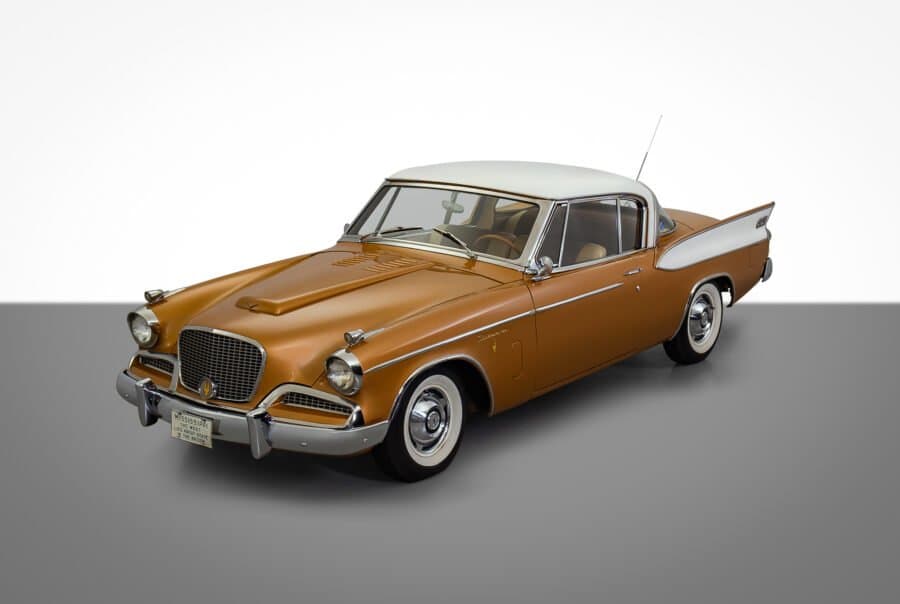
1958 Studebaker Golden Hawk: the full story
At a time when cars with fins were all the rage, Studebaker did more than follow the trend; they produced one of the era’s most memorable designs. In 1956, the South Bend, Indiana-based company found itself ahead of the curve with the Golden Hawk as one of the very first postwar luxury cars. It stands apart from the other Hawks as the only model not derived from a standard Studebaker line. On looks alone, this two-door hardtop coupe was destined to be iconic. The two-tone paint schemes, bold vertical grille, and endless chrome makes the Golden Hawk instantly recognizable. Its sharp, fast-looking hind quarters suggested the performance lurking underneath, and the 14-inch whitewall tires capped off the quintessential 1950s jet-age American style.
This is a very rare 1958 Studebaker Golden Hawk, featuring a Studebaker 289 Engine, fortified by a McCulloch Supercharger, delivering 275 horsepower. Stored with a dealership from 1976 and lightly driven until its closure in 1992, this original car was sold for storage costs and professionally restored. It received cosmetic and wear-item updates but the drivetrain remained untouched.
Drawing from the 1953–55 Champion/Commander Starliner and ’55 Speedster, the Golden Hawk emerged as Studebaker’s flashy range-topper for its new ’56 Hawk line, with early cars featuring an upright eggcrate grille, raised hoodline, squared-off trunk, and fiberglass tailfins. Later ‘57 and ‘58 models, including this one, were restyled with a fiberglass hood overlay to clear the high-mounted supercharger and concave. Also added were a round grille medallion and reshaped chrome-trimmed metal fins, as well as extended two-tone treatment to both the roof and fins.
Beauty is only part of the Golden Hawk’s appeal. Mechanically, the 1958 model year is particularly fascinating. Studebaker, lacking a full suite of large-displacement V8s, borrowed Packard’s 352-ci engine in earlier years. When Packard production ceased in 1956, Studebaker engineers pivoted to its own 4.7-liter (289 cid) liquid-cooled supercharged V8. Some thought this engine to be too large for a car this light, but it ended up producing sensational results. Paired with a 3-speed automatic, column shift, rear-wheel drive, and electric fuel pump, the 3,475-pound Golden Hawk boasted one of the best power-to-weight ratios of its era. Its straight-line performance could outrun Thunderbirds and Corvettes alike, earning a reputation for humbling overconfident rivals and helping pave the way for the muscle-car era.
The car’s interior balances laid-back comfort with high-performance. Bench-style leather seats front and rear, a padded dash, and a two-spoke steering wheel evoke an easy, breezy vibe that contrasts with the supercharged urgency under the hood. An engine-turned fascia, tachometer, and a vacuum gauge unique to ‘57 and ‘58 models. Revised suspension and driveshaft engineering for 1958 made room for three-passenger rear seating, while the spacious trunk and lavish trim reinforces the car’s grand-touring practicality beneath its flamboyant 1950s style.
Like most collector cars, rarity enhances the Golden Hawk’s aura. In the wake of the Eisenhower recession, Studebaker sold only 878 Golden Hawks in 1958 (including just 400
supercharged models), signaling the end of the line for this remarkable design. One of only 9,305 models produced from 1956 through 1958, this car stands apart with its distinctive styling, factory-supercharged V8, and unusual blend of luxury coupe refinement and serious performance. This final-year Golden Hawk is both a classic and a precursor, bridging the elegant grand tourers of earlier decades and the modern supercharged supercars that would emerge generations later.