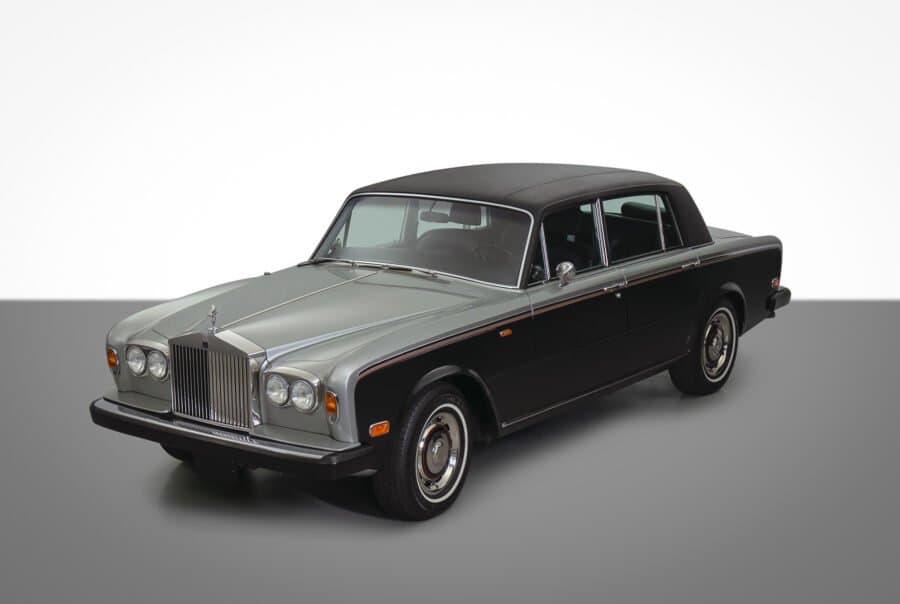
1975 Rolls-Royce Silver Shadow: the full story
At the start of the 20th century, a meeting in Manchester, England shaped the future of luxury automobiles forever. Henry Royce, a gifted engineer and manufacturer, and Charles Rolls, an ambitious automotive dealer, were so impressed with each other’s craftsmanship that they agreed to join forces. Together they launched four models under the new Rolls-Royce badge, setting a standard that would become synonymous with luxury, prestige, and automotive excellence. Introduced in 1965 and refined through the mid-1970s, the Silver Shadow marked a turning point for Rolls-Royce. It was the first of the company’s saloons to adopt unitary body construction, a bold engineering leap that modernized the brand without compromising the car’s celebrated mastery and elegance.
Over the decades, Rolls-Royce continuously upped the stakes on technology and engineering, even producing airplane and tank engines during both World Wars. While the post-war climate in England was not exactly ripe for high-end cars, the company persevered through several slim years. By the time prosperity returned, the world’s appetite for high-quality, opulent cars finally caught up to the company’s reputation for building them, propelling Rolls-Royce to its current status as the definitive luxury vehicle.
By 1975, Rolls-Royce celebrated the 10-year anniversary of the Silver Shadow, a car that modernized the brand while staying true to its heritage. This full-sized sedan was the first Rolls-Royce to feature unitary body and chassis construction, enhancing rigidity and driving refinement. Innovations such as disc brakes and sophisticated self-leveling independent rear suspension endowed the car with a ride so composed it became a benchmark for luxury saloons. Over the years, Rolls continually improved this Citroën-licensed suspension, delivering a progressively smoother ride with each model. Production of the Rolls-Royce Silver Shadow began in 1965 and lasted until 1977, with 3,134 models produced in 1975 and 16,717 in total. Rolls-Royce offered two-door versions of the Silver Shadow, including the Corniche Coupé and the Drophead Convertible, along with the Silver Shadow II, which ran production between 1977-1980.
This Silver Shadow is powered by a 411.9-cubic-inch V8 engine, which drives the rear wheels through a 3-speed automatic transmission and rear-wheel drive. Although this car was never meant for burning rubber around a track, it delivers a smooth and confident 200 horsepower. It reaches 0–60 mph in a respectable 10 seconds, and the top speed is 118 mph, which are impressive figures for a car with a gross vehicle weight rating of 5,776 lbs. Thanks to the self-leveling suspension, the Silver Shadow remains at a consistent ride height, regardless of how many passengers and cargo are being carried.
The interior is richly appointed in leather and wood, with an array of amenities far more modern than one would expect in a nearly fifty-year-old car. Remaining consistent in an era when many Rolls-Royce owners were chauffeured, the rear seating is as comfortable as the front, complete with angled footrests. The trunk (or “boot”) is spacious enough for everyone’s luggage for a country estate weekend getaway.
The Rolls-Royce Silver Shadow and its many variants are a longstanding fixture in popular culture. Featured on a Royal Mail “British Auto Legends” stamp in 2013, the car has been celebrated across film, television, music, and celebrity life for decades. The model has appeared in several James Bond films, as well as The Cannonball Run (1981) and Steve McQueen’s The Thomas Crown Affair (1968). A shell grey 1967 Silver Shadow became the most filmed Rolls-Royce ever, appearing in the British series The Avengers from 1968 through 1983. Freddie Mercury was famously chauffeured in his Silver Shadow from 1979 until his death in 1991, after which the car was displayed and later auctioned. The model also gained notoriety for appearing on the cover of Oasis’s Be Here Now album in 1997, and was favored by Japanese director Juzo Itami, who featured it in several of his films. The Silver Shadow’s enduring appeal continues to define the car as both a cultural icon and a cinematic staple.
The 1975 Silver Shadow stands as a gentleman's express that quietly redefined what a Rolls-Royce could be. The lavish saloon delivers power, refinement, and modern engineering advances without ever compromising the essence of Rolls-Royce. It is reliable, durable, and unapologetically luxurious: everything Rolls-Royce represents.