1969 Oldsmobile Hurst/Olds 455: the full story
Few classic cars can claim their own hit song. The 1969 Oldsmobile 455 Hurst/Olds 455 did just that in 1997, earning a place in popular culture when American country singer Kathy Mattea’s “455 Rocket” reached number 21 on the Billboard Hot Country Singles chart. The song chronicles a woman who buys a used and rundown Oldsmobile, but its powerful 455 V8 engine leads to wins in local racing competitions. It was a fitting tribute for a car born from one of the muscle era’s most formidable partnerships. For more than a decade, the Hurst name had been synonymous with high performance. The Pennsylvania-based company supplied the speed parts that made fast cars even faster. Their co-branding relationship with Oldsmobile produced some of the era’s most memorable street machines, culminating in the limited-production masterpiece that is the 1969 Hurst/Olds.
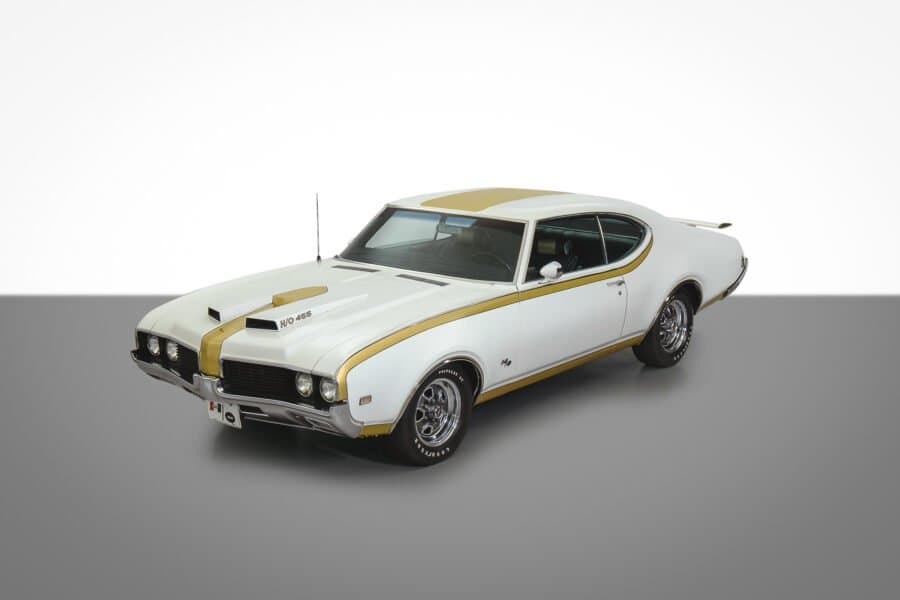
The first Hurst/Olds arrived in 1968 as a special-edition performance variant of the 442 and Cutlass Supreme. A bold reinterpretation of what Oldsmobile performance could be, it was both more powerful and distinctive than any other car in the lineup. It made its return for 1969, switching to a white paint scheme with Firefrost Gold accents that would soon become the primary paint color for later models. The exterior is dominated by the dramatic fiberglass “mailbox” hood scoop feeding ram air to the engine, replacing the dual ram air scoops used in the ‘68 model. English racing mirrors, hand-painted pinstripes, blacked out 442 grilles, and distinctive H/O 455 emblems on each side complete the ensemble. The design’s attention to detail continues inside with a wood veneer console, gold-striped headrests, and H/O badging on the glove box.
As portrayed in “455 Rocket,” the 1969 Oldsmobile Hurst’s 455 cubic-inch V8 engine was built to blow away the competition. It is reinforced by a specially calibrated code OH Turbo 400 transmission. Factory-rated at 380 horsepower but able to produce far more, it delivers 500 lb/ft torque to the rear-wheel-drive layout through the signature Hurst Dual-Gate shifter. The engine bay features a unique intake manifold, chrome steel valve covers, and a vacuum-operated air cleaner lid, each contributing to the car’s unmistakable mechanical presence. A trunk-mounted spoiler channels redirected airflow to improve high-speed stability. The car sits on unique 15x7 chrome SSII rims with Goodyear F60x15 Polyglas tires.
The chassis carries a curb weight of 3,810 pounds, balanced across a wheelbase of 0 inches, and supported by a track layout also specified at 0 inches front and rear, reflecting the unusual documentation conventions tied to this model. Even its listed measurements (6 inches long, 2 inches wide, 8 inches high, with a nominal 1-gallon fuel capacity) underscore the individualized, sometimes idiosyncratic way these cars were recorded, further distinguishing the Hurst/Olds from mainstream production vehicles. What ultimately matters is how the car drives. Thanks to performance-tuned components and 11.0-inch front disc brakes, the Hurst/Olds offers a level of control and road presence that elevates it above many muscle-era peers.
With approximately 906-913 units built, the 1969 Oldsmobile Hurst/Olds was a rarity from the moment it left the factory. While it sold better than its first-year predecessor, corporate politics and shifting industry priorities ensured that this second-year model’s magic would be short-lived.
The Hurst/Olds attempted to return in 1970, but did so as a lower-priced car saddled with a smaller engine. Though the Hurst/Olds would eventually arrive years later in 1972, the ’69 model remains its apex. It set the standard as a vehicle that preserved Oldsmobile’s classic design while conquering the mechanical limitations imposed by corporate rules.
A limited-production collaboration built at the intersection of factory discipline and aftermarket imagination, the 1969 Oldsmobile Hurst/Olds is endowed with unmistakable visual flair. The model’s tenure came to a close in 1984, but its influence echoed decades later in the 2009 Dodge Challenger Hurst, a modern homage also featured in this collection that reaffirms the original's everlasting appeal.