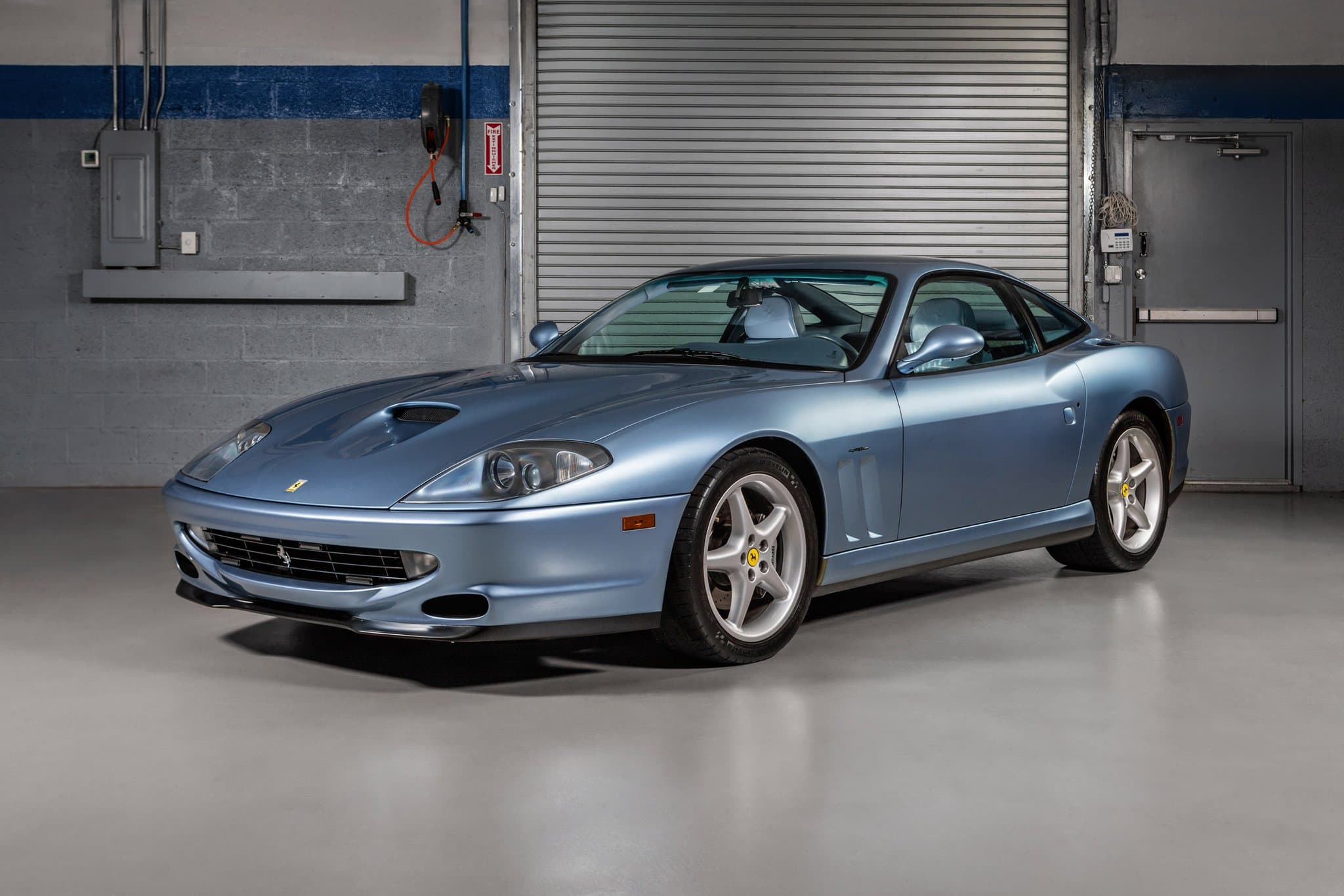
2000 Ferrari 550 Maranello: the full story
When Ferrari unveiled the 550 Maranello at a launch event at Germany’s famed Nürburgring racing circuit in 1996, it was immediately clear that it was more than a nostalgic revival. It was a worthy successor to the 365 GTB/4 Daytona, reimagined for the modern era with engineering sophistication and mature styling. Designed by the legendary coachbuilder Pininfarina, the car’s name derives from its 5.5-liter engine displacement and an homage to the Ferrari headquarters and factory’s hometown of Maranello, Italy. With 3,083 total models built between 1996 and 2001, the 500 Maranello is of the most meaningful modern Ferraris ever produced. It marked a return to Ferrari's front-engine, rear-wheel drive layout after a hiatus of more than two decades, where mid-engined sports cars took over.
Stylistically, this 2-seat grand tourer echoes its predecessors while maintaining a sense of individuality. It shares a similar frame and engine to the 2+2 456 GT, the twin exhaust air slots in the front wings recall Ferrari’s 250 GTO and 275 GTB of the 1960’s, and the tail light treatment is reminiscent of the 365 GTB/4 Daytona. The car also sports the high intensity homofocal covered headlights from the F512M model. Despite sharing similarities to previous models, the 550 Maranello has its own distinct identity within the lineage of Ferrari grand tourers. In addition to its front-engine format, the shallow and wide radiator air intake, combined with the front spoiler, give it an aggressive yet elegant expression that immediately evokes the presence of a dynamic vehicle. According to Motor Car Gallery, this car is just one of nine painted in Ferrari’s “Azzurro California” ice blue metallic color.
At the 2000 550 Maranello’s very core is the International Engine of the Year-winning F133A, a naturally aspirated 65° front V12, along with four valves per cylinder, dual overhead cams, and a variable-length intake manifold. It displaces 5,474 cc and produces 478 horsepower at 7,000 rpm, as well as 419 lb-ft of torque at 5,000 rpm. Paired to a 6-speed manual transmission, a rear-wheel drive transaxle layout, and a limited-slip differential, the car delivers an exhilarating throttle response. This car rides on a tubular space-steel chassis attached to aluminum body panels, with double-wishbone suspension at all four corners, front and rear anti-roll bars, rack-and-pinion steering, and magnesium-alloy vented disc brakes. Electronic driver aids, including adjustable anti-slip regulation and four-way ABS, provide a subtle technological safety net without diluting the analog experience. These components were not chosen for flash, but for capability, balance, and enhanced performance.
The leather-trimmed interior offers a practical and comfortable two-seat layout with electronically adjustable Daytona seats and generous luggage space behind them. Standard features include twin airbags, air conditioning, electric windows and door mirrors, plus a stereo system with a CD player. This 2000 model is enhanced by silver brake calipers, a quilted leather rear shelf and headliner, and includes both a modern Alpine stereo and the original Ferrari unit.
In the larger context of contemporary supercars, the 550 Maranello occupies a unique sweet spot. It is luxurious but deeply driver-focused, more grand tourer than exotic, yet fully capable of delivering world-class performance. This 550 Maranello is beautifully designed yet engineered for long-distance speed, and its naturally aspirated 5.5-liter V12 offers a mechanical refinement
that has only grown more appealing in an era dominated by turbocharging and hybridization. It is a car that rewards preservation, and it has aged into a modern classic without needing excessive reinterpretation.