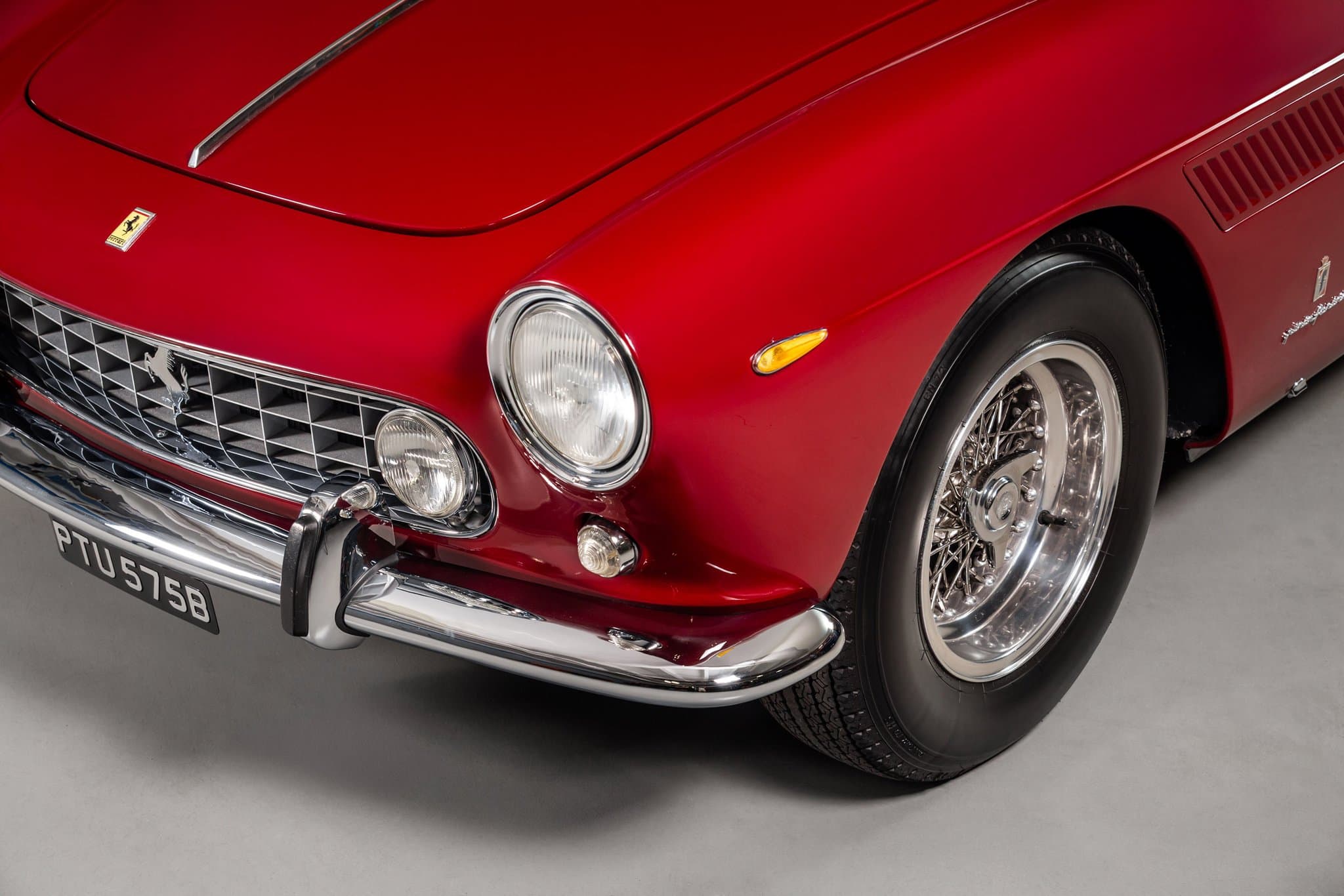
1962 Ferrari 250 GTE 2+2 Series II: the full story
The 250 GTE holds a special place in Ferrari’s history as the marque’s first true production 2+2. Styled by Pininfarina, it established Ferrari as a maker of grand touring cars that balanced speed, elegance, and practicality. Though Ferrari had experimented with a handful of four-seat configurations in the past, the 250 GTE marked the beginning of the first large-production four-seat Ferrari. Built on the same chassis as the celebrated 250 GT LWB Tour de France, Ferrari engineers cleverly reconfigured the layout to accommodate more passengers. The new “outside plug” V12 engine from Gioacchino Colombo was moved further forward, the front and rear tracks widened, and the roofline subtly raised at the rear. These thoughtful modifications made for an unmistakably timeless Ferrari that retained the sporty appeal of its numerous variants.
The car was introduced at the October 1960 Paris Motor Show, with 954 examples built across three series until 1963. More than just another addition to the revered 250 lineage, the GTE represented a paradigm shift as Ferrari’s top-selling model of its day. The wide scale run of the GTE was a major contributor to Ferrari's financial success in the early 1960s, marking a cornerstone in the company’s transformation into a global luxury car icon.
299 of the first series were built, followed by 356 Series II cars, and a final 300 of the third series. Series II arrived in 1961, receiving additional gauges and other interior changes, including a revised ventilation system. This particular 1962 Ferrari 250 GTE, completed on December 12, 1962, is the 635th of 954 total 250 GTEs built, and the 334th Series II car. This United States–market example was originally factory-finished in Rosso over Nero Connolly leather trim, and included black Borletti instruments. Distributed through Ferrari’s pivotal North American importer Luigi Chinetti, this vehicle was delivered in January 1963 to Otto Zipper Motors of Los Angeles, the renowned sports car dealer to the stars, who sold it to its first private owner shortly thereafter.
The 250 GTE spent several decades in Georgia, including time with Ferrari of Atlanta. In 2014 it received an extensive two-year restoration led by experts at Hexagon Classics of London. Today, it is refinished in a sophisticated Rosso over tan Connolly leather trim. Accompanying the car is the prestigious Ferrari Classiche Red Book, confirming the presence of its numbers-matching 3.0-liter Colombo V12, gearbox, and differential. Additionally, a history report from renowned historian Marcel Massini and complete restoration invoices, ensure absolute confidence in its provenance and condition.
An engine synonymous with Ferrari’s golden era, the 3.0-liter Colombo V12 produces a robust 280 horsepower, and is paired with a 5-speed manual gearbox and rear-wheel drive. Engineering refinements include independent front suspension, a live rear axle with leaf springs, 4-wheel disc brakes, and Ferrari’s proven tubular steel frame chassis. Weighing around 2,400–2,600 lbs with a 102.4-inch wheelbase, the car achieves a perfect balance of stability and agility, while its 20.6-gallon fuel tank allows for long-distance touring.
While Ferrari’s two-seat Berlinettas and Spiders of the era captured headlines on racetracks, the 1962 GTE Series II cemented its role as a bridge between Ferrari’s racing DNA and its future as a purveyor of refined grand touring cars. This powerful and luxurious twelve-cylinder model also represents Ferrari’s vision for expansion as a car that preserved the purity of design while introducing comfort. Its hand-crafted interior, supple leather trim, and untouched Pininfarina bodywork speak to Ferrari’s meticulous attention to detail, resulting in a historically important model that expanded Ferrari’s identity beyond its siblings.