1966 Chevrolet Corvette Sting Ray: the full story
By 1966, the second-generation Chevrolet Corvette Sting Ray had firmly established itself as one of the world’s most celebrated sports cars. Produced from 1963 to 1967, the Corvette C2 reached a particularly refined state with the 1966 model year, as subtle exterior updates and improved mechanics enhanced its already acclaimed identity.
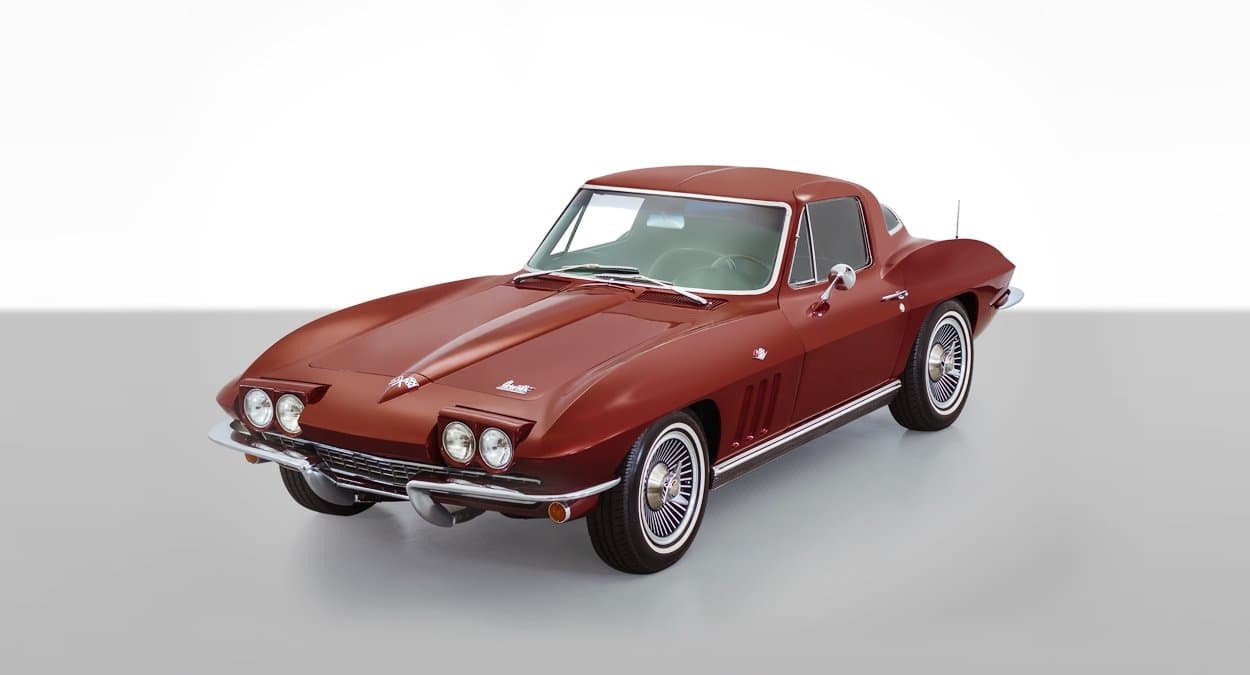
A new eggcrate grille replaced the previous horizontal bars, new wheel covers mimicked magnesium racing wheels, and aerodynamics were adjusted with the deletion of the coupe’s roof-mounted extractor vents. Corvette badging moved to the hood’s corner, new bright-metal body sill moldings added visual crispness, and backup lights became standard. The two-speed electric windshield wipers with pushbutton washer complemented the fiberglass body, robust weatherproofing, and the brand’s resilient Magic-Mirror acrylic lacquer finish. Headrests were newly available as an option for 1966, further reflecting Chevrolet’s incremental push toward comfort and safety.
The 1966 Sting Ray Sport Coupe represents this moment where sleek fender lines and a distinctive fastback roofline combined to create one of the most recognizable and coveted designs in American motoring. Finished in Milano Maroon, one of four new colors for 1966, it is also specified with several rare factory options, including the Powerglide automatic, power windows, and air conditioning, a combination that records show was installed on only 33 coupes and 7 convertibles. Despite these relatively modest but meaningful alterations, foreshadowing Chevrolet’s plans for an all-new Corvette in 1967, demand remained exceptionally strong. Production for 1966 reached a record 27,720 units, an increase of roughly 4,200 over the previous year. The design was fundamentally right from its inception, and each incremental improvement simply sharpened what had already become a world-class sports car.
The Sting Ray’s 327-cubic-inch, 300-horsepower V8 is one of the two remaining small-block offerings retained for 1966 after Chevrolet trimmed the lineup in favor of the era’s dominant big-block trend. Paired with the rare Powerglide two-speed automatic transmission, it delivers smooth, grand touring power. It lacks the brute-force surge of the 427s, but delivers its own satisfying immediacy thanks to its 4-barrel carburetor, big-valve cylinder heads, and 2½-inch dual exhaust system, and additional 1966 updates, including a more responsive automatic choke and hydraulic lifters.
The fully independent suspension, with variable-rate coil springs, a 0.750" stabilizer bar, and a sophisticated three-link rear layout, ensure that each wheel reacts independently to bumps and shocks. Combined with the frame-mounted final drive assembly, isolated by three rubber “biscuits” for reduced vibration and improved traction, the Corvette exhibits a level of composure, balance, and responsiveness unmatched by any other American performance car of its time. Inside, the 1966 Corvette elevates the sports-car experience. Leather seats, bright-metal door pulls, deep-twist carpeting, and a vinyl-covered foam headliner created a luxurious atmosphere. Designed for devoted drivers, a large speedometer and tachometer are front and center. The carpeted compartments and under-floor tool storage also maximize the coupe’s practicality.
To own and drive a 1966 Chevrolet Corvette Sting Ray Sport Coupe means experiencing a head-turning vehicle with sophisticated mechanics and cultural importance. The latter was highlighted by Sports Car International when they ranked the Sting Ray fifth among the top sports cars of the 1960s in 2004. Whether admired for its rarity, preserved for its originality, or celebrated for its road manners, this Sting Ray affirms why the C2 Corvettes remain among the most invigorating and enduring vehicles of all time.